Wednesday, July 24, 2013

Our Hero--Ensign Glen H. Rickelton, USNR

The Korean War was a two and a half year war the U.S. participated in as part of a general military engagement with other U.N. countries.  Their mission was to force the North Koreans back across an invisible line that is currently called the “DMZ” or the “Demilitarized Zone.”  Generally, historians and movie makers casually skip over this military engagement so often that this “police action” is called the “Forgotten War.”

I know about this war because I watched “M.A.S.H.” as a youngster and my Uncle Jimmy flew fighter jets during this conflict—and so did Ensign Glen Howard “Rick” Rickleton, USNR.

                                                                    
                                                                                                Ensign Glen H. “Rick” Rickelton,
                                                                                                USNR, age 23 at time of death

Usually, I change the names of the people I write about, but Rick is pretty famous here in Farmington—one of 592 New Mexico residences who died in this small engagement, most Americans do not know happened.  He’s one of my neighbors.  Liz told me about him, since he was honored last Memorial Day; and, of course, I had to find him.

Looking for Rick was easy.  He actually has several listings on Google and his military record is pretty complete on Ancestry.com.  What surprised me was the lack of details about his life and death.  There is a published diary he wrote, but I’m too poor to order it.  Besides, he wouldn’t have written about the details of his death.
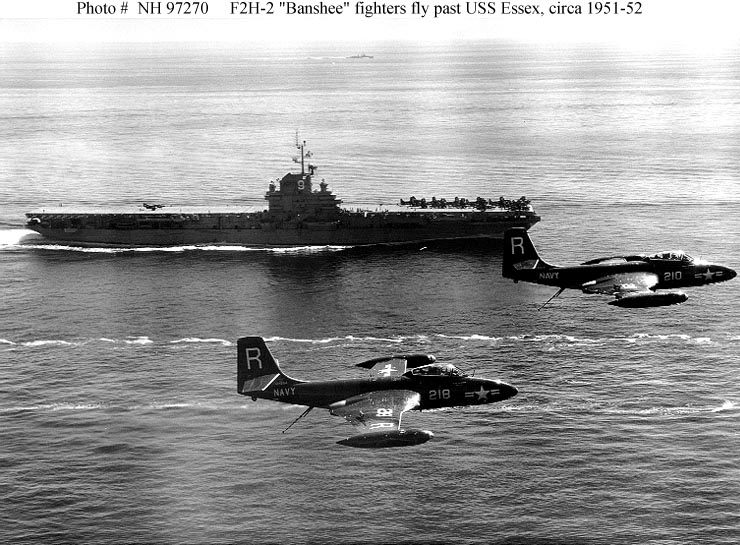

 The USS Essex CVS-9 1951

I started doing some general research, and as I learned about his ship, the USS Essex, about his bunkmate, a little known astronaut named Neil Armstrong, and the fighter squadron he flew with—51 aka “The Screaming Eagles,” I started to see what happened in my mind.  Perhaps it was because I’d seen the movie “The Bridges at Toko Ri” starring William Holden, and/or my imagination got carried away.  I could clearly see the jet’s instrument panel—Holden flew a Banshee (I think), and not a Panther, which was what Rick flew.

I saw a tan colored gloved-hand on a stick, a hose of the air mask, and dials moving as if I was flying the jet—as if seeing out of Rick’s eyes.  When this happens—and I’ve experienced such p-o-v visions a handful of times—it really shakes me up, because I actually feel as if I’m going through the person’s experience—the sensations are eerie and long lasting.

The terrain around the blue painted aircraft seemed desolate, white with thick snow, the trees barren of foliage which could be surprisingly dense in the humid heat of summer.  I got a good view of the target—a rail-line that slithered like a constrictor through the bleak contours of low lying hills, pockmarked with muddied boils from previous bombing runs.  At 25,000 feet I heard a male voice order the other members of the mission to drop to a lower altitude, to keep an eye out for MIGs and strafe the hell out of the railroad tracks which were resupplying Chinese infantry harassing U.S. Marines a mile away at a forward operating base.
 
The run went well at first, bombs were dropped, as tracers from Double A from the ground streak white-hot passed the aircraft going over 450 mph.  As Rick seemed to pull up and bank left I heard tiny sounds—thunk, thunk, thunk, thunk as they hit the aircraft, causing it to shimmy.  The projectiles moved from the nose back along the sleek fuselage.  One large chunk of metal ripped a large hole on Rick’s port side and cut a bloody line under his arm, through his chest, exiting at the top of his right shoulder.  He died instantly, and was why he didn’t eject from the plane after his squadron mates saw the left engine burst into flames.  A half a second later, the jet seemed to roll over like a dead sea lion on the surface of the ocean.  The calls of his friends reverberated in the smoke-filled cockpit.


The jet crashed into a hillside; fire and smoke of the explosion created a mini-mushroom-shaped cloud which rose as if to greet the other Panthers who flew cover, raking the enemy’s anti-aircraft gun placements with deadly 50 caliber bullets which are as long as a man’s hand and as thick as a finger. 

The Navy pilots mark the downed plane’s location, but that is all they can do—reinforcing gunfire from the ground and the arrival of four MIGs shoo the jets from the burning carcass that was once a F9F-2 Panther fighter jet.

Only after the cessation of hostilities did those pilots who had survived into the summer of ’53 remembered where their fallen shipmate had died.  His skeletal remains, badly charred but still wearing a flight suit, were recovered and sent home to find a place of prominence in Farmington’s Memory Gardens Endowment Cemetery.  There he was honored, cried over by friends and family as the wailing of a single trumpet sounding “Taps” resounded through the newly laid lawn of the gardens which had recently opened for permanent residence in 1954.

In one of the sites, I found this tribute letter from one of his former shipmates who served aboard the USS Essex. 

To Ensign Glen Howard Rickelton, USNR

October 24, 2006

Dear Glen,

This letter is 54 years late, but it's my way of
reminding myself how fortunate I've been since the
6th of January 1952 when your plane was hit by anti-
aircraft fire and you crashed and burned over Korea.

You were a very likable person to have worked
for; you treated your subordinates as friends. You
were easy going and it was a pleasure to have you as
my boss.

You've missed so much by being one of the pilots that didn't return. We were all very young and secure in that nothing could happen to us. But as the
air group's losses increased I'm sure that your initial
cockiness became wariness. You were our 13th pilot
to be lost, with 5 more to follow before the Essex
returned to the States.

Were you with us now you'd be amazed how life
has changed technologically over the 54 years. You'd
likely be a husband and Grandfather, retired and
living a wonderful life. You'd be showing your
grandkids photos of yourself as a skinny Ensign all
decked out in your flying gear, standing by your
fighter plane. But unfortunately that wasn't to be.

In 1952 I was discharged. I returned home and
got my first car and a job at Sperry Gyroscope
Company, working nights in a very boring job. By
1953 I'd found employment as a Field Engineer for
IBM. The job entailed servicing Data Processing
machines in customer's offices. There I met my wife
and married in 1961, we raised 3 wonderful children.
I retired after 39 years of a job I loved. I prospered
and now own a home in New Jersey and a summer
home at the shore in New York. Our health is good
and we're looking forward to many enjoyable years
ahead.

As a historian I've been able to retrieve all the
reports our air group filed with the Navy Department
while we were deployed with the carrier Essex off
Korea. From the reports, I compiled a list of the 50
planes and the 18 pilots lost.

Your whole life was reduced to 3 lines on 6 January
1952.

Quote: "Ensign RICKELTON of VF-51 flying a
Panther on a rail cut rec-con mission when hit by flak,
went into a shallow glide from which he never
recovered, and crashed into a hillside."

One of your Plane Captains

Bill Curtis

( William J. Curtis )


Tuesday, July 23, 2013

Part One--People behind the Memory Gardens--Liz

Improving the look of Memory Gardens has been the summer-long goal of those who labor in the cemetery, especially the landscape crew—I’ve gotten to know two by sight, but there are at least three or four more men and women.  Yet, the driving force behind these efforts to green-up the garden is the event planner, Liz, a woman of average height, a friendly and kind smile, and filled with the abundant energy of youth.

For a while I have wanted to tell you about some of the employees of my next door neighbors, and even though Liz works in the front of the office, I’ve come to see her as the little engine, whose wheels move things along. 

The back offices have two more women managing the finances and the finer details that go into carrying off a funeral with grace and dignity, and I’ll tell you about them in due time—as well as the office’s cleanliness manager who also doubles as a landscaping specialist—and the hardworking, and usually heat-exhausted landscapers—the so called “grunts” of the business.  I want to tell you about each and every one.  I admire their love for the garden and the residents they serve with such affectionate care.  Today, I will focus on Liz.

A few entries ago a mentioned her; since then, I’ve discovered her drive, her dedication, and her devotion to the job she has had for only a year and a half.  She amazes me.

I happened to be in the office chatting with her when a potential client called.  Her conversation enlightened me, not only about the daily operations of the office administration but affirmed my suspicions about her commitment to her position.

The Memory Gardens are under the hospices of The American Cemetery Association which helps fund the burials of any veteran of any military branch and allows these honored dead to be interred for free.  The gardens provide discounts for spouses to sleep beside them.  To my surprising, I discovered people who lived in Farmington, sometimes decades earlier, have had their beloved departed shipped to the gardens from as far away as Pennsylvania and Texas and a bit closer like from Colorado.  They come here perhaps to be with family already in residence, or because they were veterans, or maybe because once you have had “home” imprinted on your soul, you will always return alive or dead.

Liz knowledgeably answers any question, those coming from people on the phone or from a nosey neighbor.  There are parts of any job generally loved and hated by those who work at their occupations, and Liz seems to love many more tasks than those which may be undesirable, such as going to a county fair and suffering the heat for entire week.  I couldn’t blame her for that, this being my first summer in Farmington—but it is as hot here as it is in Utah and Idaho—and for the last two weeks as hot and humid as Omaha, which sits on the blanks of the Missouri River.

She knows stories, and I plan to dig out of her. For now, I will say, Liz is a vital cog in the machinery that has been working on improving the gardens, much like those mentioned in a parable of the Biblical lord who sent his servants into his vineyards.  The garden gathers its own to its vast lawns, sublimely ornamented with bronze and marble, both counterfeit and genuine blossoms of every hue, dark purpled butterfly bushes, clumps of heavenly light lavender, and divine and patriotic statuary.

The dogs and I enjoyed a cool morning stroll, and took a hot and steaming saunter through the park which is home to so much life and bathed in streaming light which slants so strongly in a New Mexican mountain desert.


Monday, July 22, 2013

A very short entry--frustration abounds!

I spent all day looking up a veteran of World War I, a sailor in the Unites States Navy Reserves.  I couldn't find any records of his service except for his enlistment.  I had great plans of describing sea battles with German U-boats or protecting troop transports or bar-room brawls.  Nope, I didn't find anything.  I found a mountain of stuff for a Rough Rider and a US Marine Corps pilot who flew in WWII, but for Warren, nada, nothing, nil, zip, bplllllahblat-fackinbleepincusswordsforever!

Sunday, July 21, 2013

Tributes, Eulogies, Honors and A Few Chuckles

“In Loving Memory…”  “Beloved Wife…” “…Husband…” “…Daughter…”  “…Son…” have been as constant greetings as an old, abandoned billboard along a lonely stretch of rarely used road.

Every now and again, tramping over areas of the garden the pups and I seldom tromp over, I’ll come across chiseled messages that inspire the soul, generate a prayer, cause a poignant tear, or spout a generous guffaw that will last all the way home.  I like those best.  People who rest in the gardens usually died with a good sense of humor; it is too bad that such sentiments cannot be carved into headstones or name plates that indicate the decease’s tendency to laugh at a funny situation a friend gets himself into, or giggle like children after a practical joke or an out of place pun.

The most common messages show devotion to God by the grave’s resident.  I don’t mind those, since I often read scriptures.  But sometimes I wonder if the person under the sod really went to church every Sunday, or if it is a case where the family only offers the appearance of piety when the occupant occasionally held the Good Book let alone read any of it.

On this evening’s walk, I made a concerted effort to look for the unusual, the heart-wrenching, the profound, the silly, and even the hilarious.  Here is my banquet of the sublime and the puerile, which may have fit the lodger both in age and action.

On one long married couple, on the back side of their headstones, family had added sayings which I believed showed the common sense of the dad and the loving sweetness of the mom.  His said, “Use it up, Wear it out, Make it do, or Do without.”  On her side it read, “God couldn’t be everywhere, so he created mothers.”

On another couples’ stone was something more touching:  “May the God of hope fill you with all the joy and peace as you trust in Him, so that you may overflow with hope by the power of the Holy Spirit.” Romans 15:13.  Like I said, scriptures are popular, such as ‘Oh that you would rend the Heavens…” Isaiah 64:1 or my personal favorite from Luke 24:5 “Why do you seek the living among the dead?”

Better yet are the ironic sayings that usually the people ordering the stone didn’t quite get.  The one which caught my attention belonged to a young man who died at the age of 21.  The saying was simple but made me choke on the incongruity.  It said, “David So-and-So, Daring and Lucky.”  How lucky could he have been if he died at such a young age?  Was he so daring that he did a stunt that landed him under the sod of Memory Gardens?  See what I mean—ironic.

 Sarah’s tribute from her family was true and poignant:  “Mother will live on through the actions of her children and by the state of her friends.”

Another devoted mother’s ever-lasting accolade read:
“Upright and faithful in all her ways,
a wonderful person to the end of her days,
a loving mother true and kind,
a beautiful memory she left behind.”

A gentleman had this engraved upon his head:
“God took him home,
It was His will,
But in our hearts,
He liveth still.”

Another couple’s children gave this eulogistic quote: “Together forever with a lifetime of golden memories.”  I’d would have put that on my own parents’ graves if I could.

A 59 year old semi-truck driver’s homage was more practical and accompanied by a picture of a big-rig.  It simply said, “On the road again.”

Another young man had this honor:  “His courage, His smile, His grace, Gladdened the Hearts of Those who had the Privilege of knowing him.”  I was told days earlier he had died of cancer.

A few blogs ago a wrote about Ethan, who always makes me smile, but I laugh when I read the back of his headstone:  “Our Little Worm….It’s a long way to the top if you want to Rock N’ Roll.”

On still another couple’s read granite headstone reads the familiar poem:
“Love bears all things,
Believes all things,
Endures all things,
Love is forever.
Love never fails.”
The postscript (the best part) lets the passer-by know the most important part:  “We’re good.”

I shall leave you with my favorite. 
 
Whenever I am too depressed to function, I find Marguerite’s stone—I know exactly where she lies—next to her son who died two days after her own passing.  This is a woman after my own heart.  Above the dates of her life it reads: 
“I told you I was sick.”

I would have believed you, Marguerite.  Perhaps I might have even taken you to the doctor.
 
I’m still laughing.

Walk Through Memory Gardens Cemetery--the film

I couldn't think of a better tribute to all the soldiers, sailors, marines, and those who left those who loved them too soon than this film I made this morning.
I hope you found the video interesting and as I described it.  The pups and I still go there for a walk twice daily, expect on Sundays when we only go once.

Thursday, July 18, 2013

Martha in an Unmarked Grave

One of the saddest things at Memory Gardens Cemetery are the number of unmarked graves--over twenty--perhaps thirty that I've come across on our twice daily walks. 

Yesterday, I passed one in the middle of the veterans section in the center of the cemetery.  I got about six paces passed it when something hit me like one of the poor schmucks on America's Funniest Home Videos who gets hit in the crotch or runs head-first into a garage door.

Obediently, I returned to the depressed green and brown grass, stood at the foot of the bed and said, "OK, I'm listening," closing my eyes.

I got nothing at first so I was about to open my eyes and walk the dogs homes when I got a voice.

"Martha."

"So you're name's Martha?"

"Martha, Martha, yes."

"What do you want, Martha?"

"Bury my son."

"I don't get it; you want me to bury your son?"

"No, Barry, my son."

"Oh, I get it.  Barry is your son."

"Yes, yes, yes."

"Why didn't he give you a headstone or name plate?"

"Not living in New Mexico.  He's gone--gone."

"He could still have ordered you a stone from where he is.
"Hates me--doesn't want to have anything to do with me."

"That's horrible!  Why would a son desert his mother without marking the place where her dead body lies?."

"Hates me.  He hates me."

"I don't understand.  Did he do something to start such feelings?  Or did you do something?"

"Me, me--I did it."

"This is surprising.  What did you do?"

"I nagged and nagged until I drove him away."

"I'm sorry, Martha.  That's hard."

"I nagged and nagged.  I wanted him to be the man I knew he could be, but it only drove him away."

"That's pretty brave of you to admit you made the mistake.  Most would blame the other person."

"I wasn't a good mother.  But I love him.  I really love him."

"As mothers do--or should do."

"I'm forgotten.  No one remembers me.  I'm alone."

"Martha, I'll be your friend.  I'll make sure the pups and I walk by your grave and remember you, alright?"

"That's very nice of you, young lady."

"My name's Beth."

"Martha."

"No last name?  No, wait, I don't want to know it.  Martha's good enough.  It was nice meeting you Martha.  See you tomorrow morning."

"Good-bye, dear."

"Bye."

This morning I found one of my old flower pots decorative sticks that has "relax" on the top.  I found a card, and wrote a message for Martha on it then put it at the head of her grave--feeling pretty proud of myself.

This afternoon, I found the sprinklers had knocked the card off the stick, but it was only four inches away.  I fixed it and stuck the stick back on her grave.  Told Martha I was thinking of her.  A warm, sweet feeling swept through me.  Thanks Martha, I enjoyed meeting you, too.

Where Martha lies forever.

Wednesday, July 17, 2013

Poor, old men and the medals they didn't earn.

I am learning that finding a story to write on everyday for this blog is difficult.  I see a lot of names, meet a lot of people, but it surprises me how similar their stories are--like the young Army Sargent and his mother the pups and I met last night.  "Troy" had managed to survive two tours in Afghanistan only to come home, hop on his motorcycle and die in a horrible crash.  (By the way, his mom did not look old enough to have a twenty-three year-old son as handsome as Troy.)

Another problem is, when I get a name, it takes me one to two days to do all the research I can which either validates what I feel about them, or completely surprises me--I told you I'm running about 50% with my "intuitions."

On our walks last week, I met one World War II veteran I'll call "Donny."  His granite and copper head-plate announced his service as a p.f.c. (private first class) in the army air corps, and that he had been the recipient of a "Silver Star" one of the U.S.'s three top medals for valorous conduct above and beyond the call of duty a soldier or sailor or pilot could earn.

Two days later, I met "Charlie," who was also a private and had an engraved announcement he had earned a "Bronze Star"--also one of the three top honors as well as a purple heart.

Since I was, of course, curious to learn exactly what feats of amazement under enemy fire they had performed, I spent several days trying to find their precise military service records, the units they were in, what theater they fought in (either in Europe or in the Pacific), and a description of their citations.

I searched for hours after discovering a site that had all the names of all the men and women who earned the top five meritorious medals, including the purple heart--earn for receiving a wound in combat--for all major wars and conflicts, from the Civil War to America's War on Terror. 

The people who control the site have been fastidious about dates, names, award, and the description of the citation--as well if the soldier died due to his heroic actions, and if he saved others in the course of what any recipient would say was "just doing my job." 

The word "hero" never comes out of their mouths if you're lucky enough to get one of them to talk about the incident--most won't even mention the experience, let alone describe what they did to get the award.

I spent so much time looking for Donny and Charlie's names on the rolls of honor, I thought perhaps the site was incomplete, so I had to find another only to come up with the same results--nothing.  Then it hit me--why don't you look up a name of a Marine you know won several awards, and if he's on the site then Charlie and Donny should be there, too.  So I looked up my Uncle Jimmy, and sure enough, there he was and his three citation for meritorious service--two during World War II and one during Korea.

Quickly I looked for Donny and Charlie, careful to spell their names correctly before clicking "search."  Each time I got the same result.  "Sorry, no results for ---- could be found."

What came to my mind was sad, pitiful and a bit tragic. 

Both men had come home from the war, not very proud of their service--I learned Donny hadn't even left the States.  Once they got home, friends, family and town-folks all demanded to know what happened.  Talk about peer pressure.

Not wanting to sound as if what they did was little more than shuffle papers or supplies from one combat unit to another, both men told stories about how brave they were--about how patriotic--ready to stare the enemy in the eye and do something so miraculous even they didn't know how they survived the events. 

I can see them telling the same story or stories again and again, first to family then to friends, and finally to grandchildren who were enraptured that the old man telling the story was ever young enough to have done the heroically described tale.  The more the two old men related their fictions, they even started to believe they had actually performed those courageous actions, believed it so vehemently that if they had taken a polygraph, the machine would not indicate deception.  That's the sad part.

The tragic part is, even if all they did was shuffle papers, reports and communiqués, even if all they did was count rolls of toilet paper, cans of beans, or belts of ammunition, even if that was all they did for the two to three years they were enlisted in the US Army, they were doing vital and important jobs--jobs they should never have felt ashamed of doing. 

If these two men hadn't shuffled those reports or counted those cans of food then how could the combat units have been able to do all they did in order to be called "American's Greatest Generation."  If an intelligent report doesn't reach the correct hands then a unit of Marines making an amphibious landing on some Japanese held island wouldn't have known what they were facing.    If those belts of meticulously counted ammo didn't reach the B-2 airborne units who made bombing runs everyday over targets in Europe, they wouldn't have been able to protect themselves from the German fighters who attacked them before reaching their targets.

Yes, they did vital, important, and necessary jobs, but they weren't proud; in fact, they were ashamed--they must have been because they told their families they had won medals.  Perhaps they even found some military surplus store and bought the actual medals in order to validate the stories they told.  That's the pitiful part.


My Daddy Lt. Commander
Rufus W. Boldman
I had to beg my dad, Rufus Wilson Boldman, to tell me some of his war experiences he endured while working first as an ordinary sailor to finish the war as a chief petty officer.  He didn't win a single medal, although he did get honors for facing the enemy--honors written in reports that didn't come with a piece of shiny metal--only raises in rank and pay.  Now I know the stories he told were heavily edited--were stories that gave him nightmares twenty years after they happened (when I was pestering him for them).  I loved knowing my father saw combat and on his World War II service ribbon got to have a small metal star set in the middle--displayed on his khaki suit coat or his khaki shirt to show his service--even as the gold colored oak leaves pins told everyone he had earned the rank of lieutenant commander (that's like being a major in the army).  He wouldn't never agree with me he was a "hero."  But he was my "hero" even though he didn't even get a purple heart.  When he told me he hadn't gotten one, I said, "That's alright daddy.  It means God protected you all the way through the war 'cause He didn't want you getting hurt."


Seaman First Class, Rufus Wilson Boldman


It was my Uncle Jimmy who was the "real" decorated family hero.  He had enlisted before his brother, and had joined the U.S. Marines.  Since he had gone to college he got to be a first lieutenant--daddy was only in his first year he had started at the bottom, as he would say. 

Uncle Jimmy, that's Lieutenant Colonel James Dean Boldman (his rank at his retirement), had had the adventures one could write a book about--and a man he knew only in passing--Pappy Boyington--eventually did.  My uncle knew navy and marine giants--like Boyington and Jimmy Thatch, who won the Congressional Medal of Honor and created the "Thatch-weave," a tactic needed in
order to bring down a Japanese Zero because the Navy's aircraft, prior to getting the Chance-Voight Corsair, were inferior to the superb banking and climbing ability of the Mitsubishi enemy plane.

the only picture I have of Uncle Jimmy on Orcas Island in the San Juans


As a U.S. Marine, Uncle Jimmy earn two meritorious medals for valor in World War II, but I like the story about the third better--liked it so much I used it in one of my novels set during World War II. 

He was a captain in Korea, the commanding officer of an air group, and the small air field they flew out of was continuously being shelled first, by the North Koreans then by the Chinese.  One day, when the enemy started the mortar hoping to take out his groups' aircraft, Uncle Jimmy got so pissed off, he grabbed the nearest enlisted man, handed him a radio (those were large box-like instruments that had a telephone receiver but needed to be wound up to generate enough electricity to send a verbal communication).  The two marines got as close to the enemy as they could; Uncle Jimmy confirmed the story after I hounded him about it.  He swore and told me daddy's version was full of "sh--" and he had to set the record straight because daddy couldn't tell a story correctly even if he was paid to do it. (Daddy was in NIS and wrote accurate reports as part of his job.)


"We got so close to the Chinese we could smell the rotten kimchee on their bad breath," Uncle Jimmy said--his way of saying they were close enough to see them while keeping themselves from becoming obvious targets.  They wound up the radio and gave map coordinates to their artillery units who were supposed to protect the airfield from mortar attacks.  The two men stayed there, under fire for over an hour--long enough for the artillery to hone in on the Chinese mortar crews and wipe them off the face of the earth.

He told me directly--eye to eye--"I was doing my job, girl, so don't go calling me a hero.  I didn't want any more of my planes destroyed or any more of my pilots wounded or killed.  I did what needed to be done.  That's all.  End of story."

He was angry as he told me--I think he was mad that daddy had told me his brother was a great warrior and pilot.

I grinned at the old Marine, proud of him as much as I was of my dead father. 

Because Uncle Jimmy didn't want me to think he was so great, he told me a story about how five Kiwi (New Zealand) pilots had saved his ass from being shot full of holes from four Japanese Zeros which had managed to jump him, after he got separated from his unit and wingman while heading back to Henderson Airbase on Solomon Island.
 
"They killed three and the other two bugged out," he said, suddenly sounding younger than 70, his face changing, hardening, one hand trembling unconsciously.  "After I limped home and got out of that damn death trap (his Corsair), I threw up all over myself.  Heroes don't puke on themselves, girl.  I wasn't a hero."

I didn't believe him.  His denials confirmed my suspicions that he was, indeed, a hero--one who desired the medals he received for actions in combat.

But so were Donny and Charlie.  If men like them didn't do their jobs, my daddy and uncle wouldn't have been able to do their jobs.  If only they could have realized how important a role they played, they wouldn't have had to make themselves liars. 

No, they didn't win "pretty-trinkets" as Uncle Jimmy called his citations; no, they weren't the "heroes" killed in movies; but they were heroes.  They were doing the jobs that needed to be done in order to save U.S. property, but more importantly, to save lives in combat zones--places neither of these two old dead man ever came close to seeing up close and personal.

                     My Uncle Jimmy getting the Bronze Star during World War II.